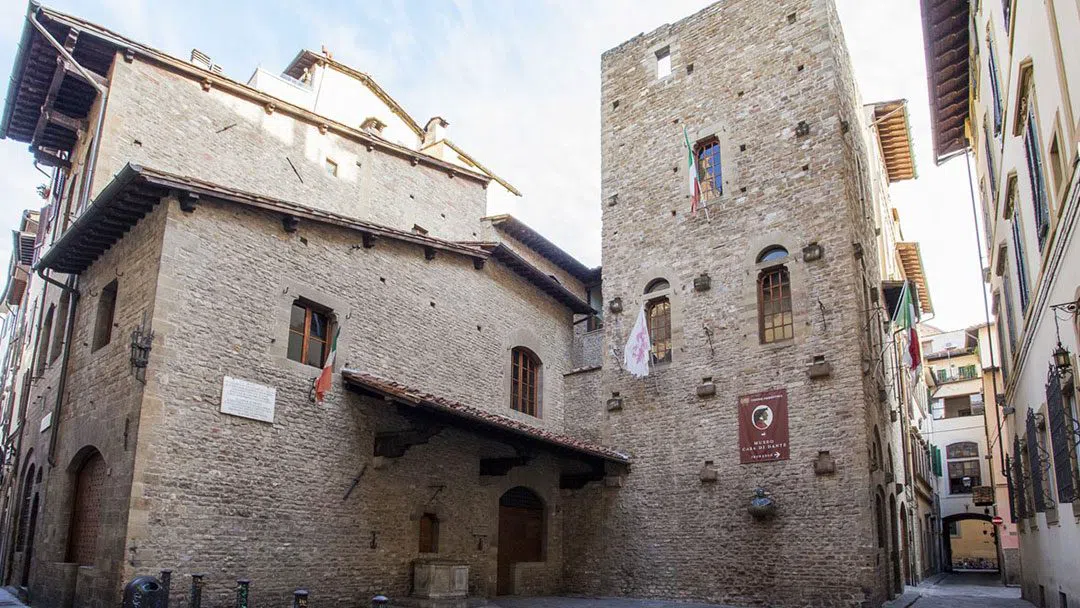

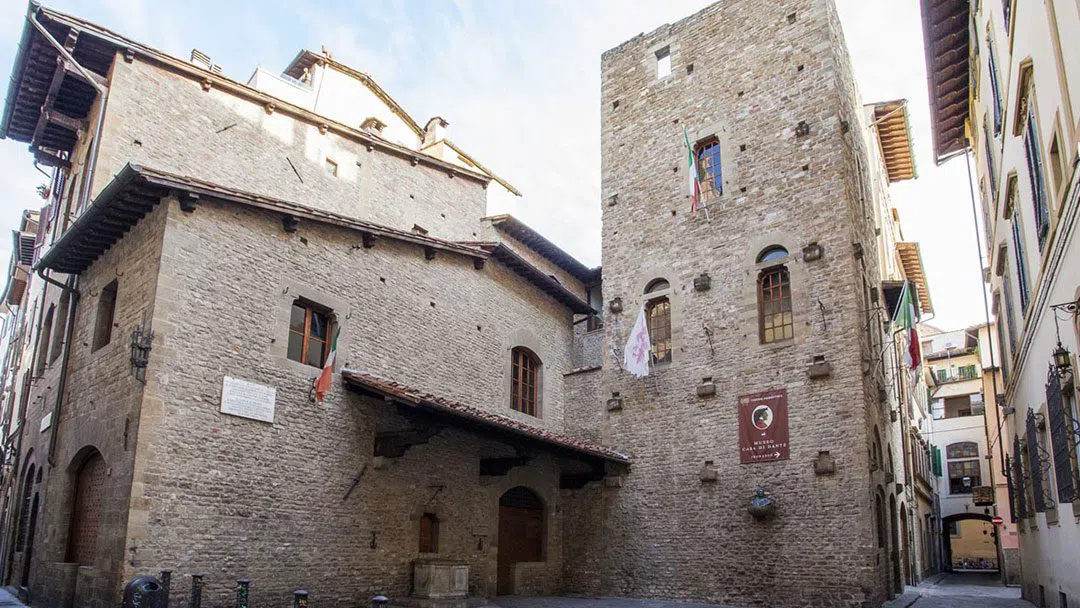
October light in Florence arrives late and low, and at nine in the morning Via Santa Margherita is still a slot of cold stone barely wide enough for two people with umbrellas. At the end of it, under a small iron sign, stands a grey tower-house with four or five people waiting outside. It is not Dante's house, and you want to know that before you hand over eight euros.
What the house on Via Santa Margherita actually is
Museo Casa di Dante (Via Santa Margherita, the lane threading between the Duomo and the Badia) is a 1911 reconstruction raised on the plot the Alighieri family owned. No beam, no chair and no floor tile in it was touched by the poet. What the city built on that land is a three-floor interpretive museum: one floor on the life, one on the poetry, one on the Florence of his time. Screens, models, projections and reconstructions of arms, coins and city walls do the work, not original furniture, and an honest account has to say so in the first paragraph rather than the last.
Once you accept the terms, the place does something that no gallery of authentic objects manages. In about the time it takes to drink a coffee, it explains how a wool-merchant city of tower-houses and factions produced a man who was a doctor's guild member, a cavalryman, a city councillor and then an exile with a death sentence hanging over him. You come out able to read the street outside, which is what the ticket buys.
Entry is €8 full and €5 reduced, school groups of fifteen or more pay €3, and children under seven go free. For a fuller picture of how the quarter fits into the rest of the city, see our Florence guide.
What you see on the three floors
The lower floor handles the life: the family, the guild membership, the Guelf and Ghibelline quarrel that ran through every street in this quarter, the military service of his twenties, and 1300, the year he sat as one of the city's Priors. Cases of reproduction armour and a wall-sized city map do most of the work.
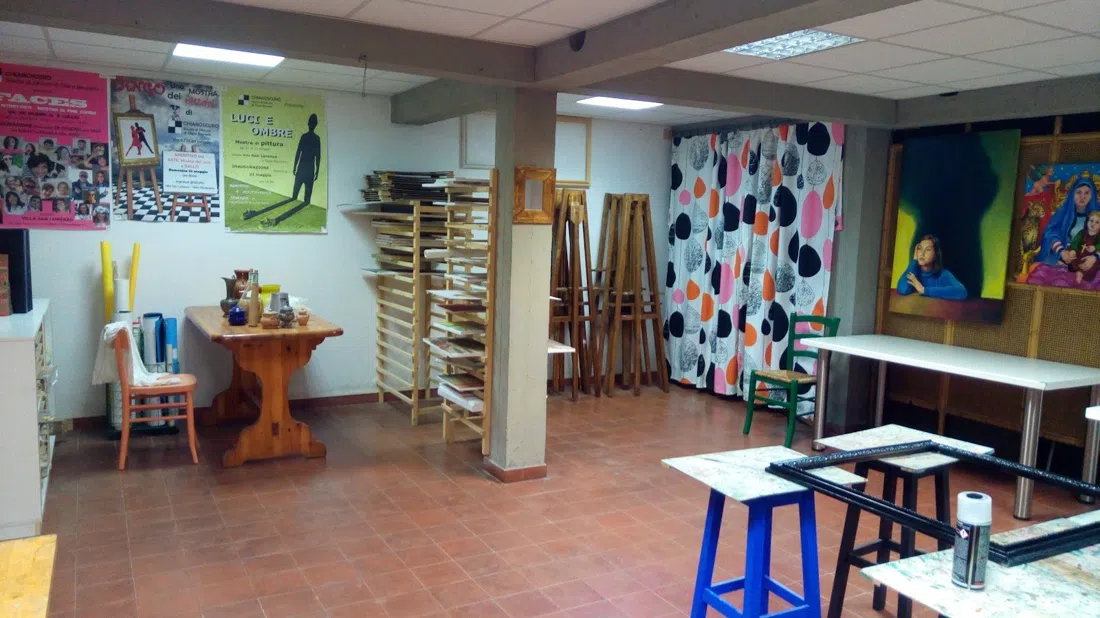
The middle floor is the poetry: the early love lyrics, Beatrice, the structure of the Comedy laid out as a diagram you can follow, and the exile that produced it. The top floor turns back to the city itself, what stood where, which families held which towers, what he would have seen from his own door. A workshop room sits up there too, used for school sessions and temporary displays.
A lift reaches the ground and the first two floors. The third floor and the workshop room are stairs only, with no alternative route, which is worth knowing before you buy.
How long it takes and when to walk in
Forty-five minutes to an hour is the honest figure. Read every panel and watch every projection and you will spend ninety minutes; move briskly with a teenager who wants the sword cases and you will be out in half an hour.
Through October the museum keeps its long season: open daily 10:00 to 18:00, with last entry at 17:30. That runs to 31 October. From 1 November it contracts to Tuesday to Friday 10:00 to 17:00 and Saturday and Sunday 10:00 to 18:00, closed Monday, so a trip that straddles the end of the month is, in practice, visiting two different museums. Anyone arriving in the first days of November should check the day before building a morning around it.
The two quiet windows in October are the 10:00 opening and the last ninety minutes after 16:00. Between about 11:00 and 14:00 the lane fills with guided groups working the Dante circuit, and because the rooms are small, four groups inside feels like forty people.
Buying at the door or arranging a guide
Walk-ups simply buy at the door; there is no booking system for individuals and no timed slot to miss. Any party of more than six must reserve in advance, and groups of fifteen or more get the €5 reduced rate. On public holidays and peak days admission can be capped for space and safety, so a large family turning up unannounced on a busy Sunday may wait.
A guided option exists, and it is worth being clear about what you are buying. There are 314 traveller reviews across the bookable walks that take in this address, and the top-rated one holds 5.0 out of 5 from 235 reviews; the booking platform flags that same tour as likely to sell out. Prices start from 224 USD per person. Set against an €8 door ticket, that price buys three hours of a licensed guide walking you through the whole quarter rather than entry to the museum, and it earns its keep only if you want the streets explained rather than the display cases read aloud. Independent readers who like their own pace should take the €8 ticket and walk the route below.
The church at the end of the lane
Thirty seconds from the museum door, Chiesa di Santa Margherita dei Cerchi (the same lane, Via Santa Margherita) is the smallest room in the quarter and the one people tend to remember. A dozen people fill it. Guided groups queue outside on the flagstones and rotate through in clusters of six or eight, which in October is a pleasant few minutes in the cold shade and in August would be unbearable.
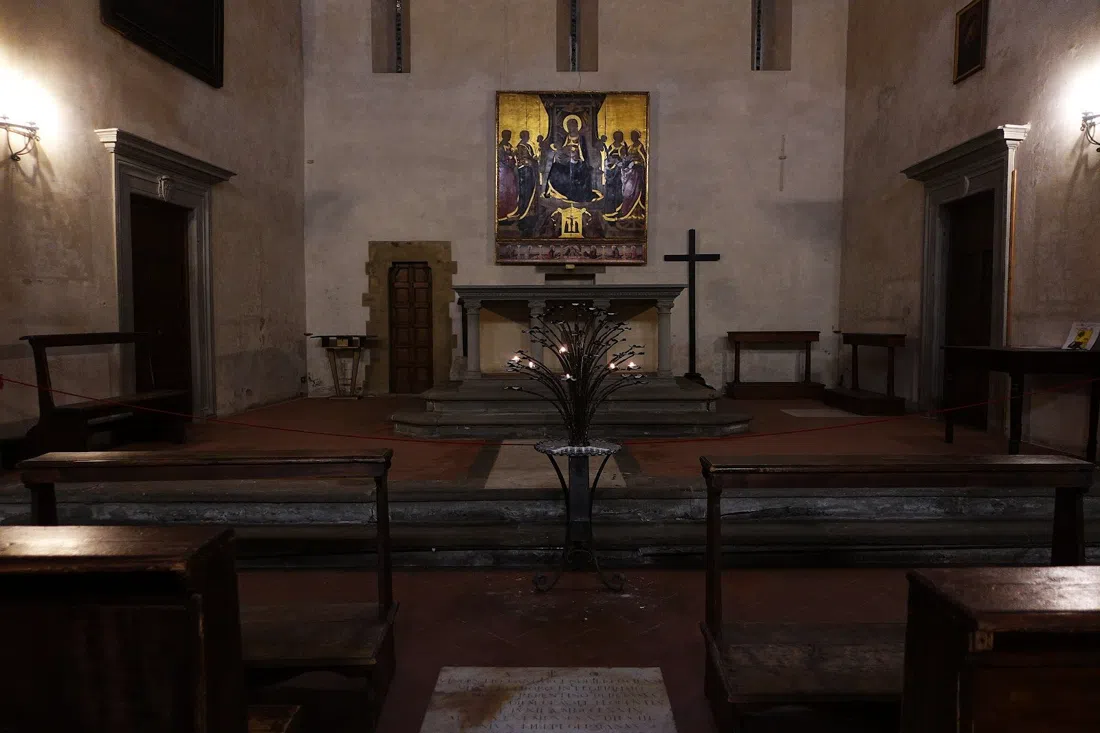
Entry is free with a donation box. The hours are short and genuinely erratic, broadly late morning, roughly 10:30 to 12:30, with some afternoon opening, so treat it as a bonus you may collect rather than a fixed item on the plan. Walk past twice in a day and your odds improve.
Two doors that open only on certain days
One square south, two small sights run on their own calendars and catch people out.
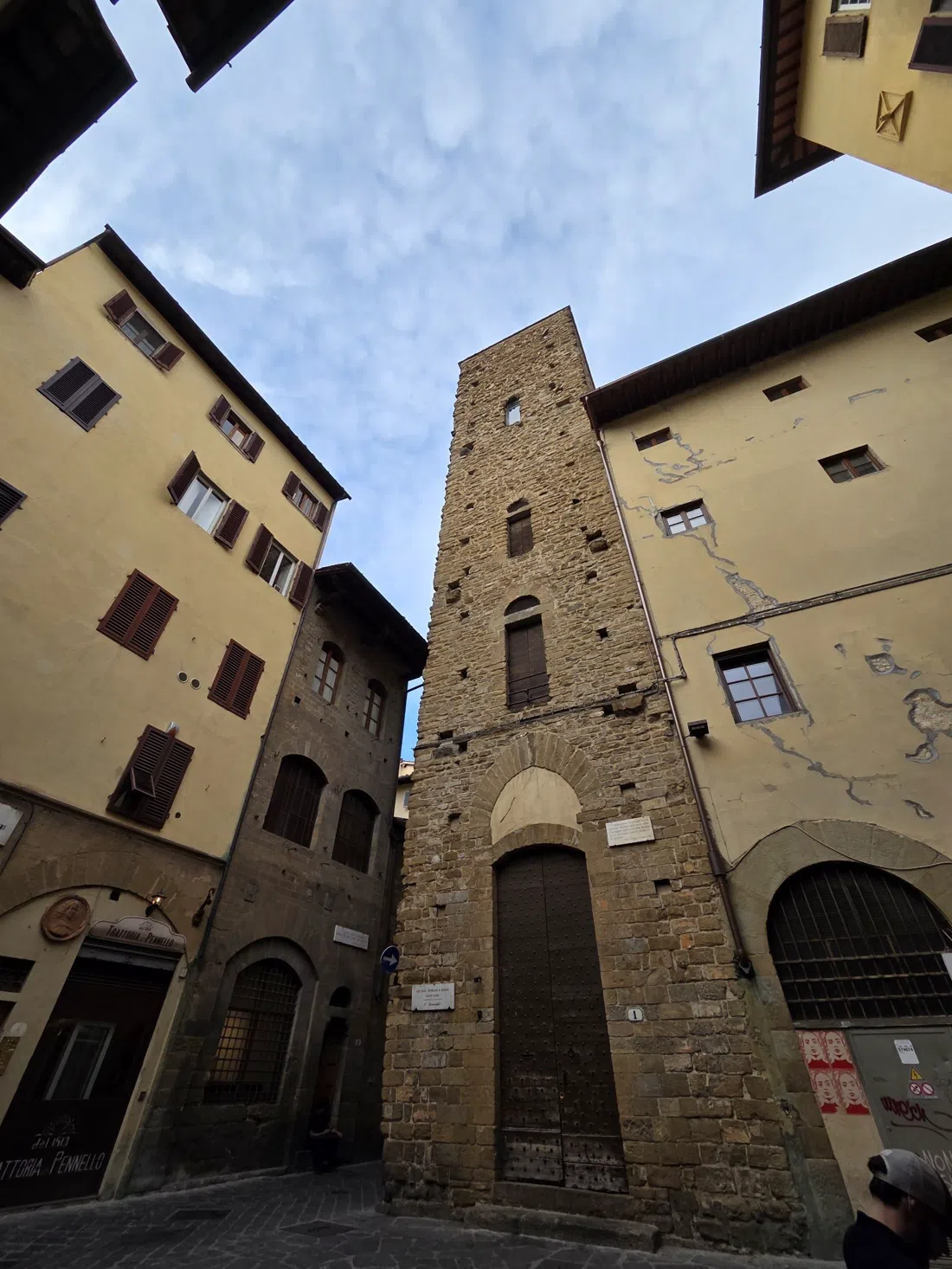
Torre della Castagna (Piazza San Martino, directly across the little square from Dante's house) is where the Priors of Florence first met, the office Dante himself held in 1300. It is two rooms, free with a donation, and the upper floors belong to the neighbouring court and are shut to the public. The Garibaldi veterans' association opens the ground and first floors on Thursday afternoons only. Never promise anyone a visit without checking first.
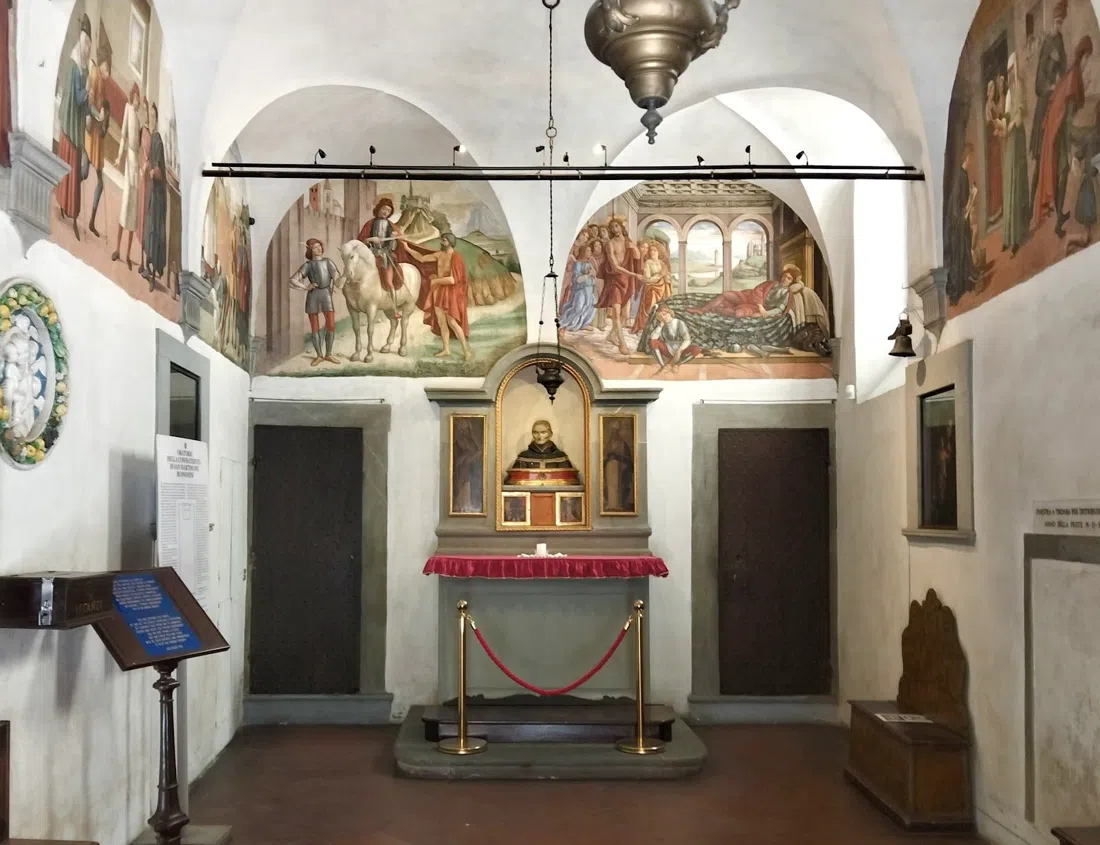
Oratorio dei Buonomini di San Martino (the same square) stands on the church of San Martino al Vescovo, traditionally where Dante married Gemma Donati. Inside, a room-sized cycle of lunettes from Ghirlandaio's workshop shows ordinary Florentines being fed, dowered and buried, fifteenth-century daily life set down with a directness no reconstruction reaches. It is free, it holds perhaps eight people comfortably, and voices stay low. Open Monday to Thursday and Saturday 10:00 to 12:00 and 15:00 to 17:00; Friday and Sunday mornings only.
The medieval city three streets away
If the reconstruction leaves you wanting the real thing, it is a five-minute walk.
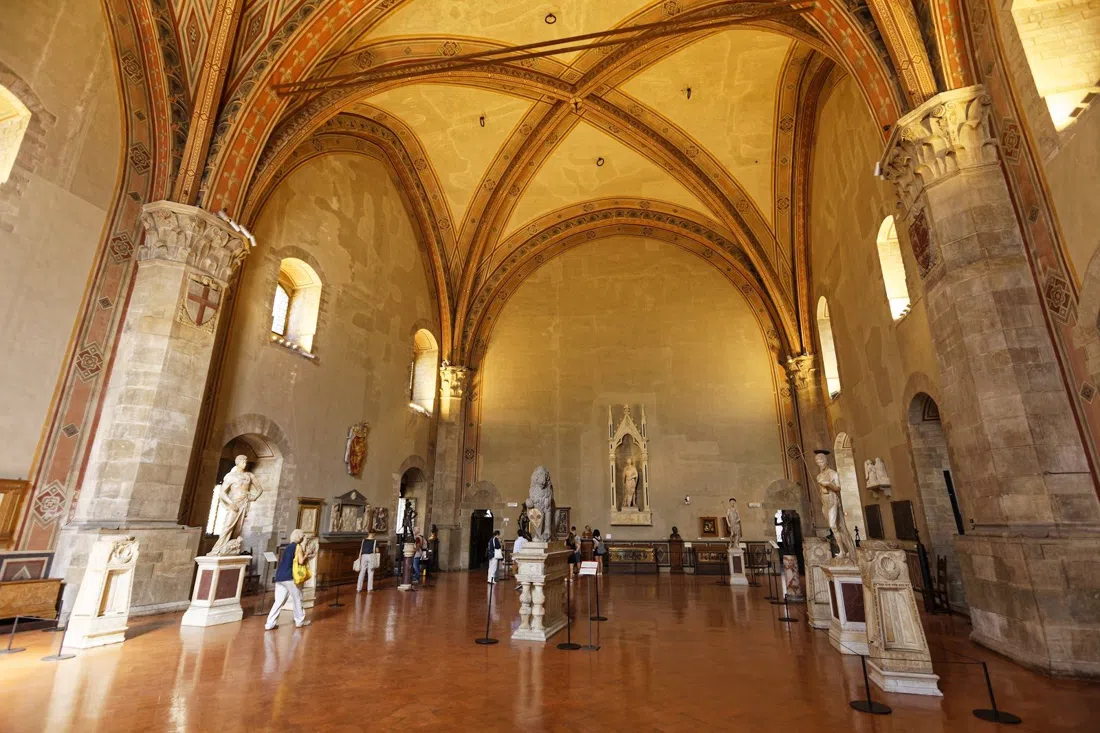
Museo Nazionale del Bargello (Via del Proconsolo) pairs best with the Casa di Dante: the medieval portrait of the poet held here is the genuine artefact that the museum's holograms reconstruct. Since 15 March 2026 it runs unified hours, Tuesday to Sunday 8:15 to 18:50, closed Mondays and on the second and fourth Sunday of the month. Tickets are €12, or €26 for a 48-hour combination with the Accademia, or €38 for a 72-hour pass covering all the sites in its group.
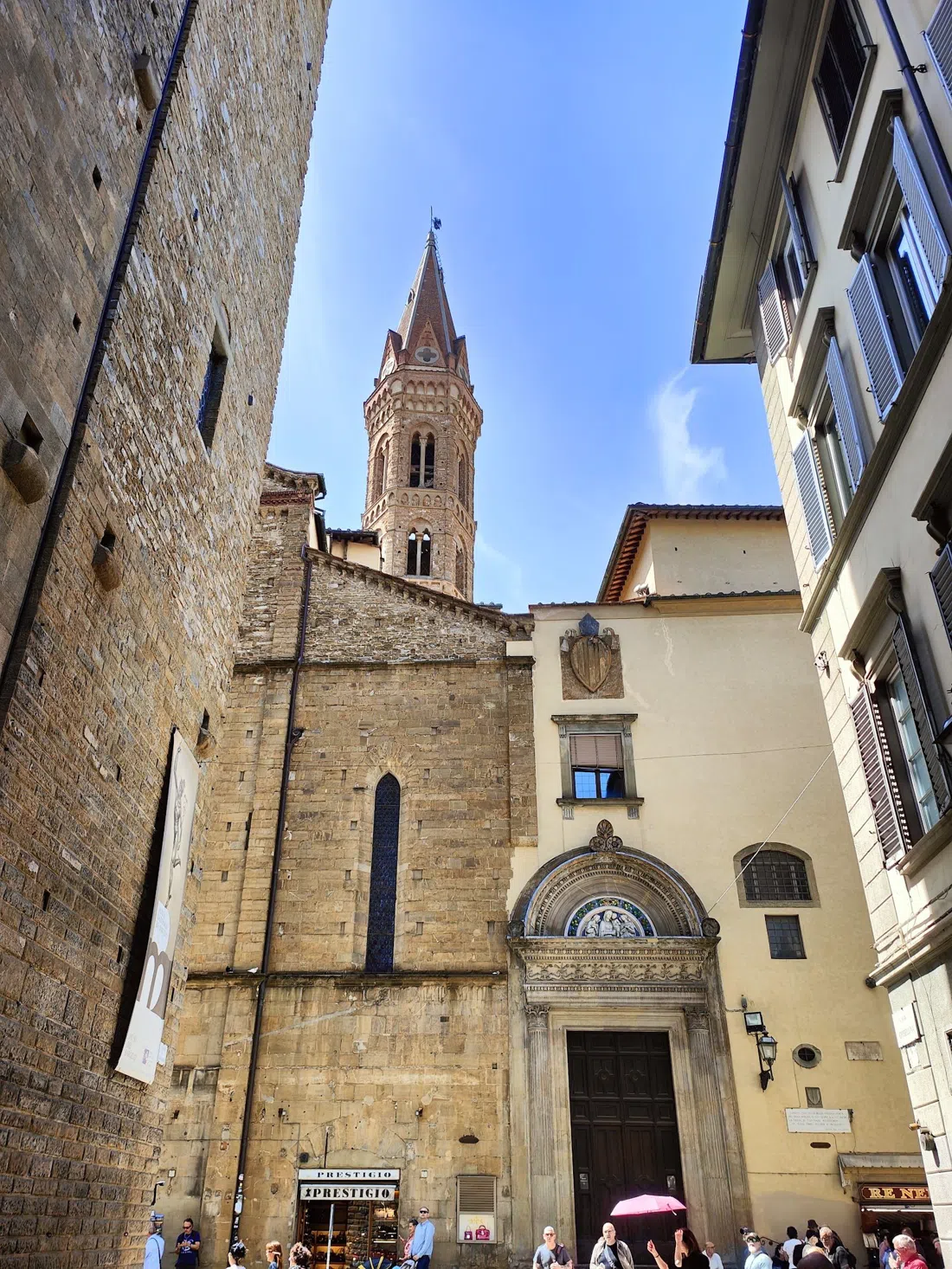
Facing it, Badia Fiorentina (Via del Proconsolo) rings the bells Dante names in Paradiso. It is a working monastic house and the visiting hours for tourists are deliberately narrow: Monday 15:00 to 17:30, Tuesday to Saturday 7:00 to 19:00, closed Sunday, and shut for the whole of August. That Monday slot is the only window for the Chiostro degli Aranci, the Orange Cloister, ticketed separately at €3 while the church itself is free. Small quiet groups only, no amplified guiding, and steps at both entrances mean no wheelchair access.
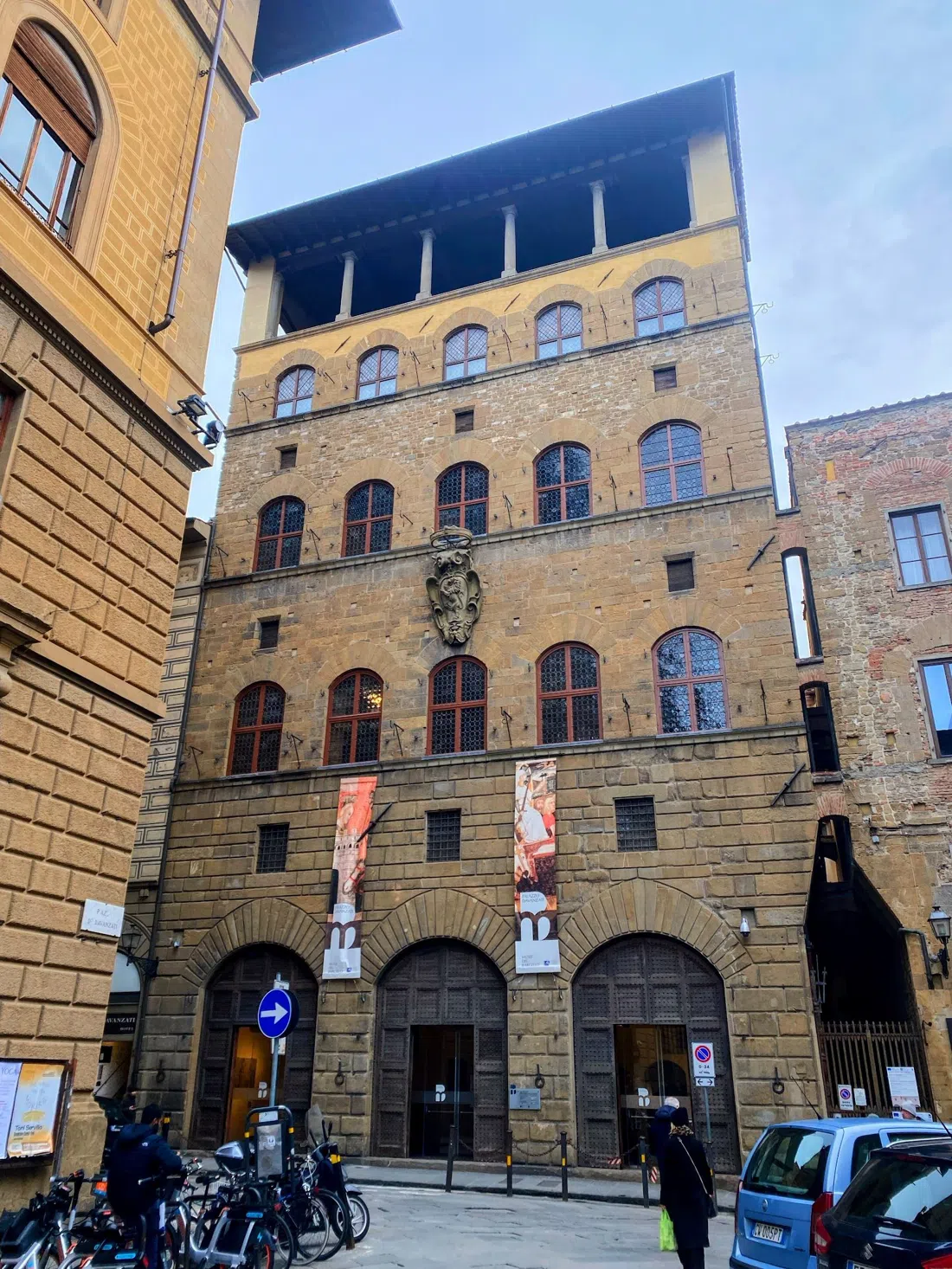
Museo di Palazzo Davanzati (Via Porta Rossa, ten minutes from Via Santa Margherita) answers the question the Casa di Dante cannot: what a house of that period actually looked like, furnished, painted and lived in. It is €8, included in the €38 pass, Tuesday to Sunday 8:15 to 18:50, closed Monday. Rooms are small, so guides split parties.
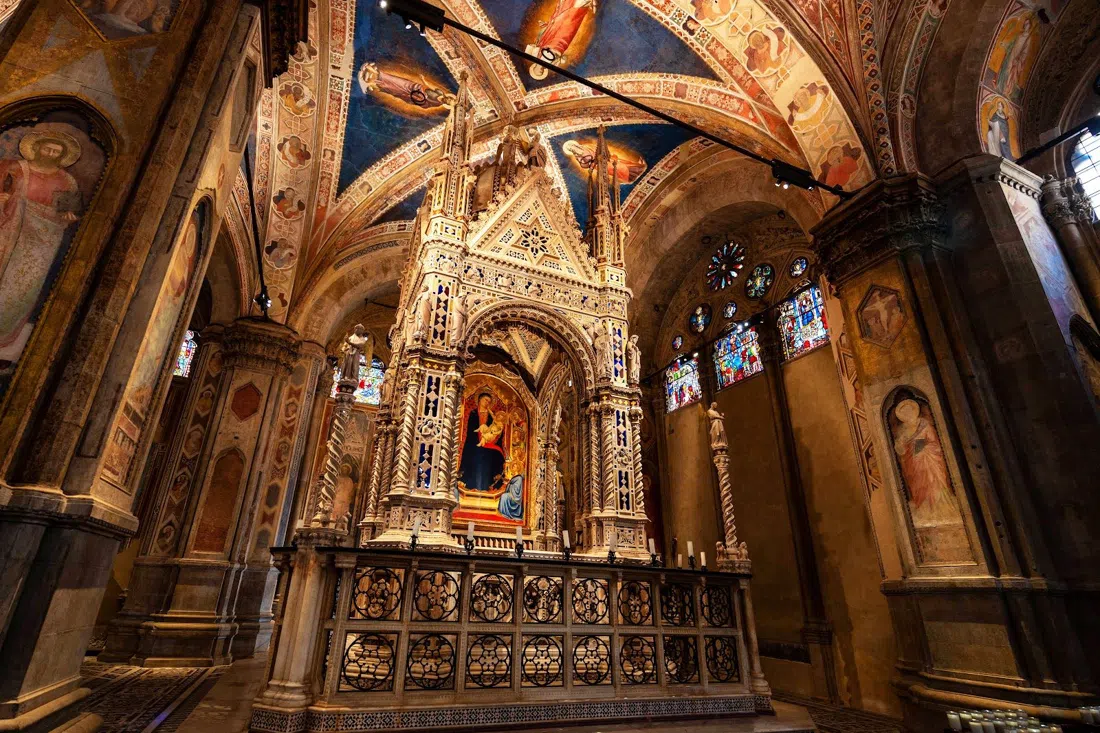
Complesso di Orsanmichele (Via dei Calzaiuoli) was an open grain loggia in Dante's lifetime before it became a church hung with guild statues. The upper hall is back on regular visits, Tuesday to Sunday 8:15 to 18:50, closed Monday, last admission fifty minutes before closing; on Sundays the church stops admitting visitors at midday for services. Tickets are timed, €10 full and €2 for ages 18 to 25, free under 18, with a €3 booking fee.
Attached to it, the Società Dantesca Italiana in the Palagio dell'Arte della Lana (the same block as Orsanmichele) has run public Dante readings from this building since 1903. It is not a walk-in museum; access is through the Lectura Dantis readings, lectures and pre-arranged visits, and most public events are free. Email ahead and confirm the programme before you build a day around it. An October evening reading, in Italian, in that hall, is the least touristic hour in the quarter.
The government that exiled him
Museo di Palazzo Vecchio and the Torre di Arnolfo (Piazza della Signoria) is the seat of the government that sentenced Dante to exile in 1302, and the tower is the highest viewpoint within five minutes of his front door. October is its season: the haze of summer has gone and the light off the tiled roofs at four in the afternoon is worth the climb.
The climb is the catch, 418 steps, no lift, no step-free access anywhere on the route. Entry is by timed slot and strictly capped, so arrive fifteen minutes early; no under-sixes at all, and under-18s must be with an adult. The tower closes in rain, though you can still walk the medieval ronda walkway when it does. Tower hours are 9:00 to 17:00, and 9:00 to 14:00 on Thursdays. The museum costs from about €12.50; the Arnolfo Tower is €20 full and €13 reduced, with tower-only tickets from €8 in some combinations.
Where Dante is not buried
Basilica di Santa Croce (Piazza Santa Croce) holds a large and solemn monument to Dante, and the tomb is empty. He died in exile, was buried where he had been given refuge, and that town has kept him ever since despite centuries of Florentine requests. Better to say so plainly than let a first-time visitor stand in front of the monument believing something untrue.
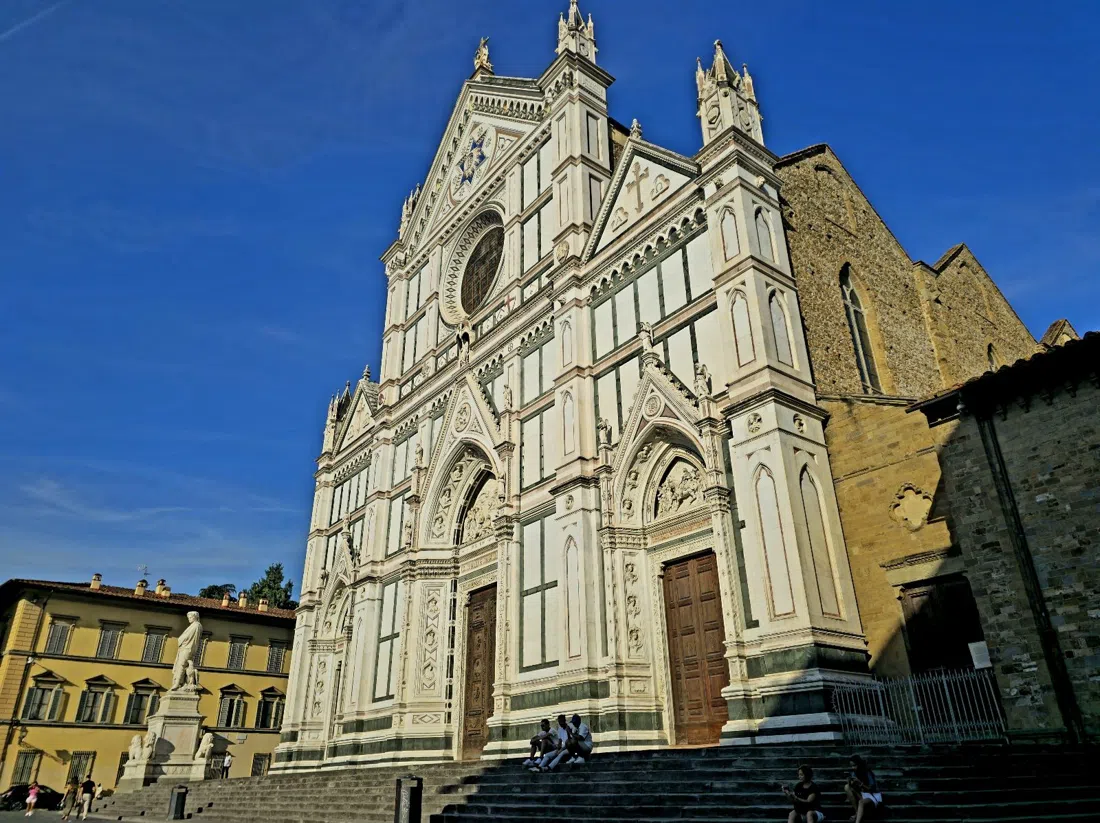
Go anyway. The basilica is one of the great medieval interiors and the rest of the floor is a roll-call of the city's dead. It is €10 full, €6 for ages 12 to 17, students and groups of 15 or more, free under 12. Groups run up to 35 plus a guide, and parties of 15 or more must use radio earphones, rented at €1.50. Booking is recommended rather than required. Open Monday to Saturday 9:30 to 17:30, Sunday and religious holidays 14:00 to 17:30, with no admission after 17:00.
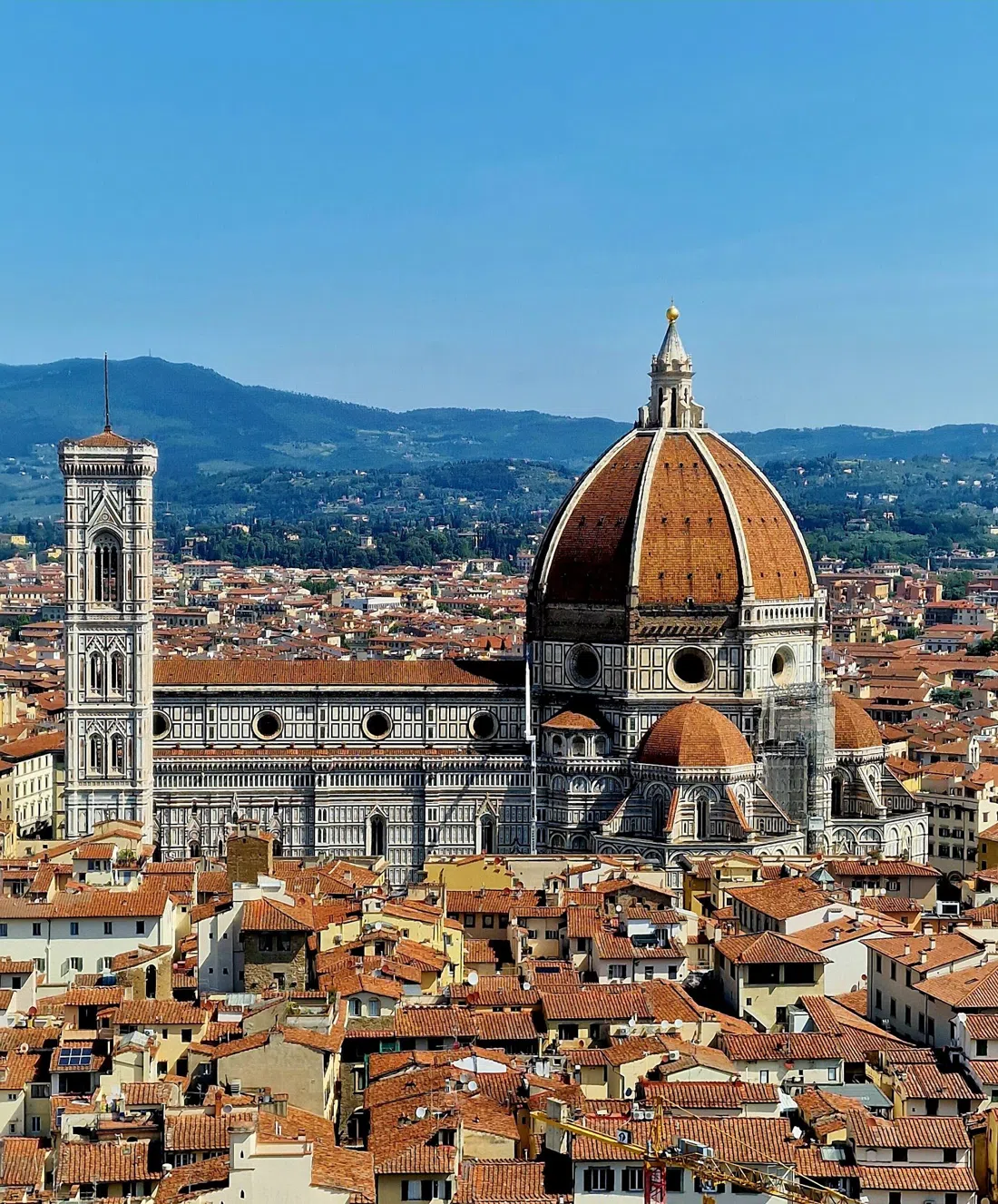
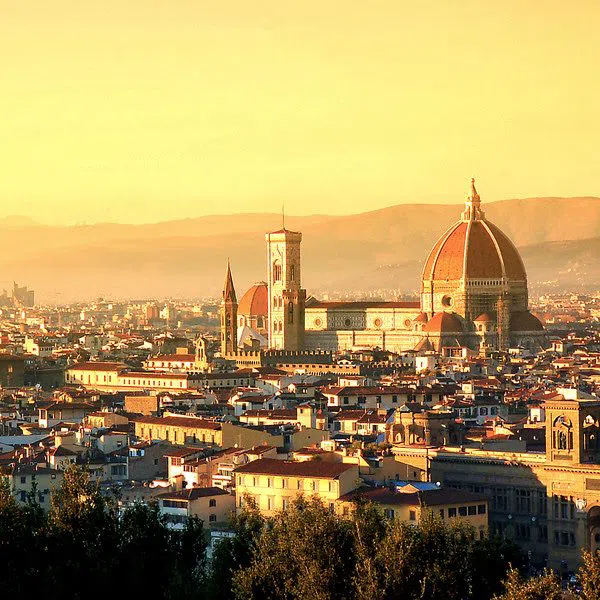
One more, and it costs nothing: inside the Cattedrale di Santa Maria del Fiore (Piazza del Duomo) hangs the painting of Dante holding the Comedy with the terraces of Purgatory behind him and the walled city at his shoulder, the image every reader of the poem has seen reproduced. Cathedral entry is free; the constraint is the queue along the façade, which in October moves steadily if you join it before 11:00. Open Monday to Friday 10:15 to 15:45, Saturday 10:15 to 16:30, Sundays from 12:45, and closed to sightseers during services.
Coffee, a panino and a table nearby
Chiaroscuro (Via del Corso, three minutes from Piazza San Martino) is Mokaflor's own roastery bar and the sensible stop before a 10:00 museum opening, coffee from €1.50 to €5, more with pastries or at aperitivo. Note the weekday rhythm, roughly Monday to Friday 7:30 to 21:30. It is a bar format, fine for a few people and too tight for a tour group.
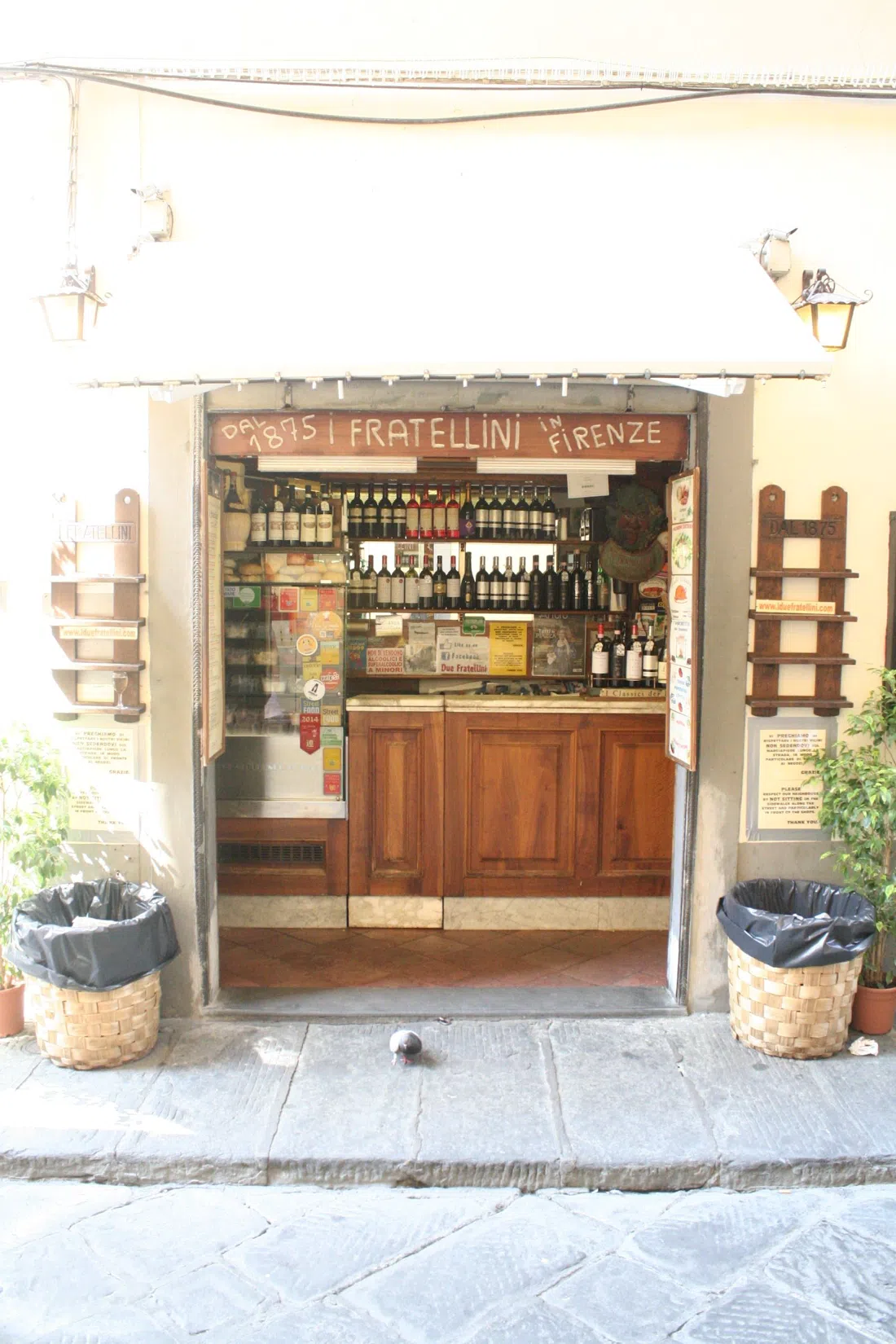
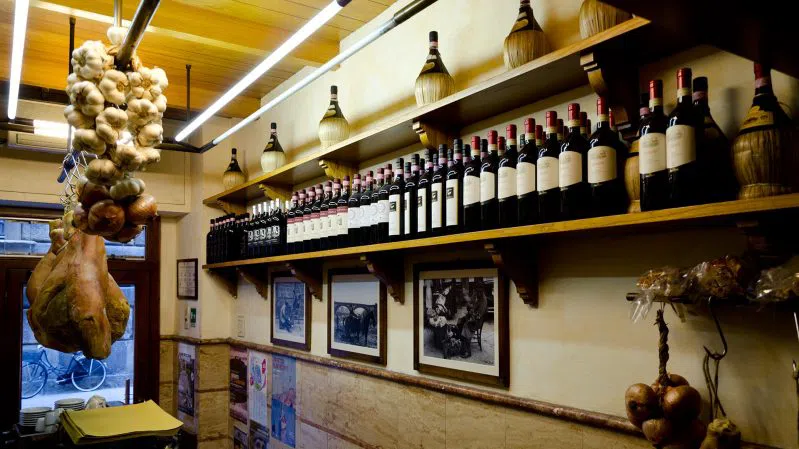
I Fratellini (Via dei Cimatori, two minutes from the museum) has been selling wine and panini through a hatch in the wall since 1875. There is no indoor space whatsoever; you eat standing against the opposite wall, which on a bright October lunchtime is exactly right and in heavy rain is not. Around €5 a panino, €7 for schiacciata, wine by the glass from a couple of euros. Monday to Saturday, roughly 9:00 to 20:00, or until the bread runs out. Six or eight people works; twenty is chaos.
For a proper table, Trattoria Le Mossacce (Via del Proconsolo, one street from the Badia and the Bargello) has been family-run since 1925 and costs €15 to €30 a head. It is elbow-to-elbow tiny, it takes bookings and you should make one for anything over four, and it serves weekday lunch and dinner only, 12:00 to 14:30 and 19:00 to 21:30, closed Saturday and Sunday. Weekend visitors are caught out by this constantly.
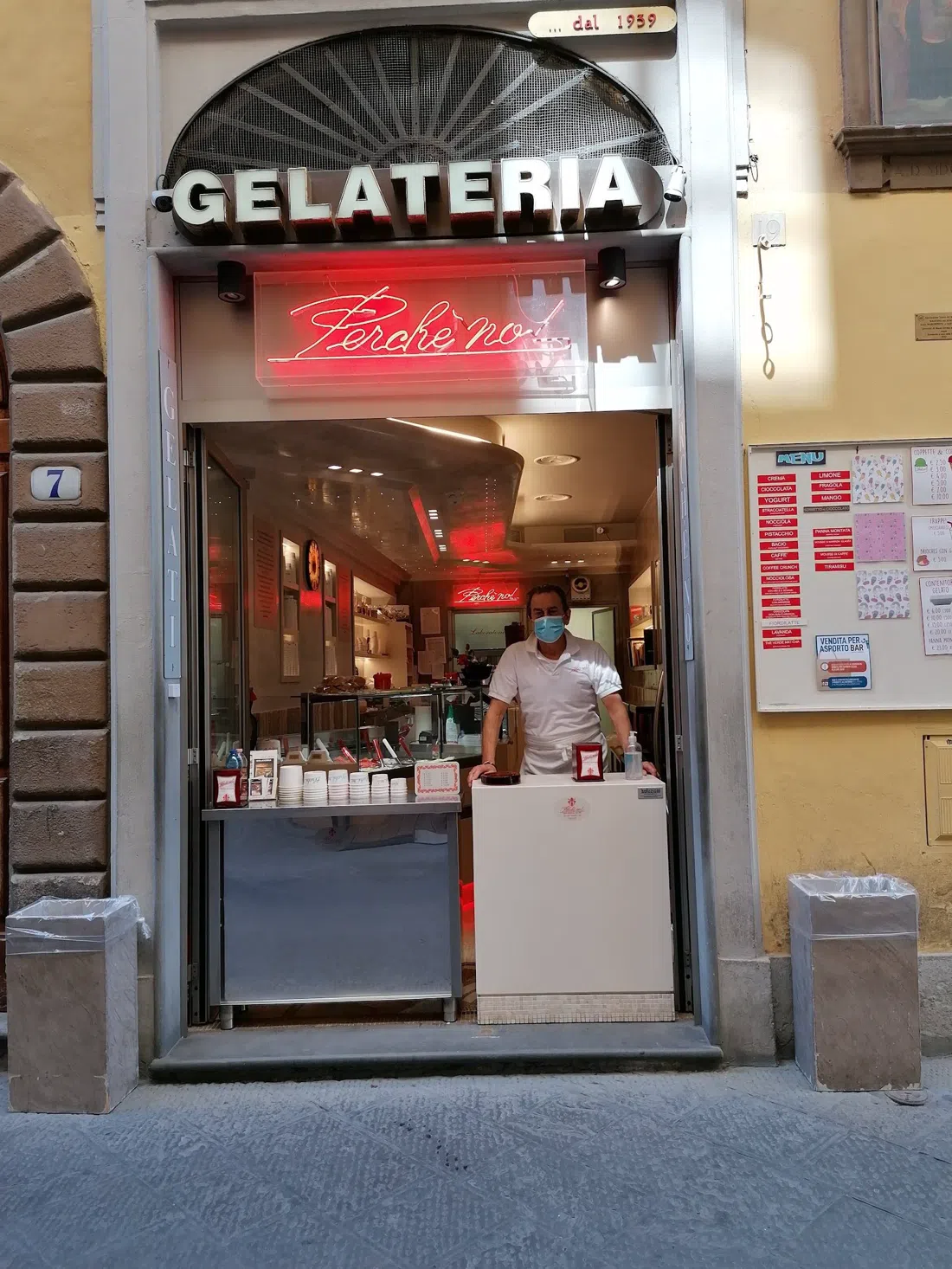
And Gelateria Perché no!... (Via dei Tavolini, a 200-metre detour) is one of the oldest gelaterie in the city, €3 to €6 a cone, usually closed on Tuesdays. Its hours are seasonal and shorten as the autumn goes on, so an October evening cone is a matter of checking the shutter rather than assuming.
Picking your hour and your day in October
October is the good month here for a specific, unromantic reason: the museum still keeps its long summer timetable to 31 October, daily 10:00 to 18:00, while the crowds that clog these lanes in July have thinned. Go at 10:00 sharp and you will have the first floor almost alone; go after 16:00 and you will share it with a handful of people finishing their day.
The day of the week matters more than the hour. On a Monday, the Bargello, Orsanmichele and Palazzo Davanzati are all shut, but the Casa di Dante is open, and Monday 15:00 to 17:30 is the only window all week for the Badia's Orange Cloister, so Monday's route is Dante's house, the Badia and Santa Croce. On a Thursday, Torre della Castagna opens its two rooms in the afternoon, while the Arnolfo Tower closes at 14:00, so do the tower first and the tower-house after. On a Sunday, the Badia is closed, Le Mossacce is closed, Santa Croce opens only at 14:00, Orsanmichele stops admitting at midday, and the Bargello is shut on the second and fourth Sunday of the month; keep Sunday for the museum, the cathedral painting and a long walk.
Rain is the other October variable. The Casa di Dante, the Bargello and Palazzo Davanzati are entirely indoor and make a strong wet-weather afternoon; the Arnolfo Tower will simply be closed.
Is it worth it
At €8 for forty-five minutes, yes, with a condition. It is worth it if you want to understand the man and the city and are content to get that from screens, models and clear explanation, or if you have read the Comedy, or are about to, and want the political geography to stop being abstract. It suits couples, solo readers and families with children old enough to follow a story, and it is one of the few places in central Florence where a group of six can turn up without a plan.
It is not worth it if you are coming for original objects and a preserved interior; you will feel cheated, and you should spend the money at Palazzo Davanzati and the Bargello instead. It is not worth a long detour on its own. It is very much worth being the first stop of a half-day walk through the quarter, which is how the museum itself is designed to be used.
Practical notes for an October visit
The whole quarter sits inside the pedestrian and limited-traffic zone; no taxi will reach the lane and no car should try. From the main railway station it is about twelve minutes on foot. Everything in this article is within a ten-minute walk of the museum door except Santa Croce, which is fifteen.
Cards are accepted at the ticketed museums. Carry twenty or thirty euros in small notes and coins for the free sights, since Santa Margherita dei Cerchi, the Oratorio dei Buonomini and Torre della Castagna run on donation boxes, and for the panino hatch, where cash is simply faster.
Allow one hour for the museum, half a day for the museum plus the churches and towers of the quarter, and a full day if you add Santa Croce and the Arnolfo Tower. Book nothing except a table at the trattoria and, if you want it, the tower slot.
A thorough independent day comes to roughly €8 for the Casa di Dante, €12 for the Bargello, €3 for the Orange Cloister, €10 for Santa Croce and €20 for the tower, about €53, plus a €5 panino and a €4 gelato. The 72-hour €38 pass pays for itself if you are doing the Bargello and Palazzo Davanzati and staying three days.
Anywhere between the Duomo and the Signoria puts this entire walk on your doorstep, though it is the noisiest and priciest strip in the city; a room across the river costs less and adds ten minutes. Compare rates and areas with our Florence hotel search.